Buy Now Pay Later is about to become more than a payment option. For retailers, it is becoming a checkout, marketing, customer service and compliance issue all at once.
From 15 July 2026, many third-party BNPL products will fall under Financial Conduct Authority regulation for the first time. The main obligations will sit with lenders, but retailers should not assume they can simply leave everything to Klarna, Clearpay or their chosen provider.
The way BNPL is presented on a website, described in an advert, promoted in an email or explained by a customer service team could all come under closer scrutiny.
That matters because BNPL is now woven into the retail experience – it appears on product pages, checkout screens, homepage banners, paid ads, social posts, FAQs and in-store displays. What once looked like simple sales copy may soon need to be treated much more carefully.
For retailers, the question is no longer just whether BNPL helps conversion:
The question is whether the entire customer journey is ready for regulation.
Why The Rules Are Changing
BNPL has grown quickly because it solves a simple retail problem; customers like flexibility, and merchants like anything that helps reduce hesitation at checkout.
However, regulators have become increasingly concerned that some customers may not fully understand what they are agreeing to, particularly when credit is presented as a quick, frictionless payment choice. The new rules are intended to bring greater structure and protection to the market.
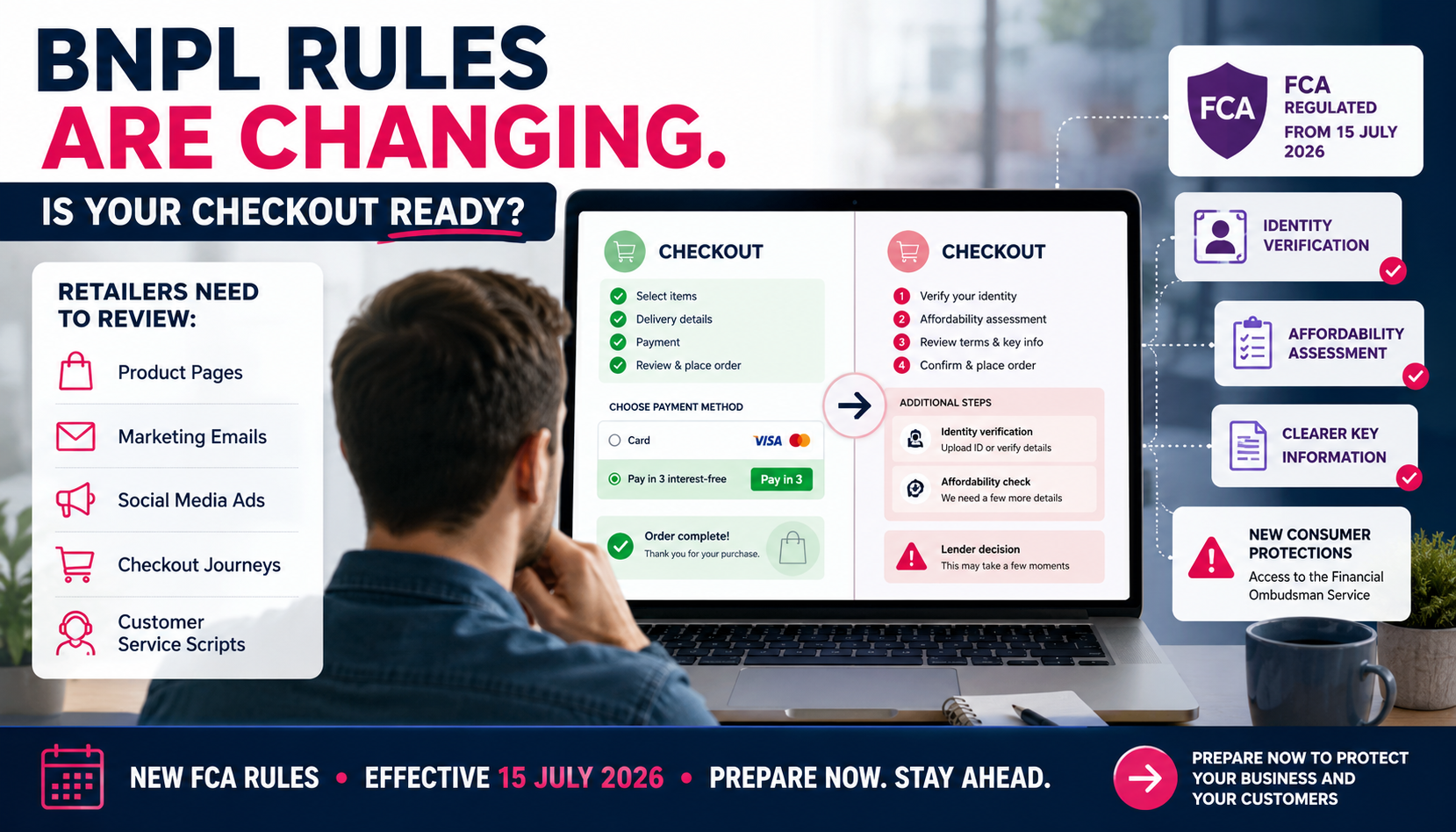
From July 2026, many BNPL lenders will need to provide clearer pre-contract information, carry out affordability and creditworthiness checks, support customers who are in or approaching financial difficulty, and handle complaints in line with FCA rules.
Eligible customers will also have access to the Financial Ombudsman Service for complaints related to the BNPL product, its promotion, or the lender.
For consumers, the aim is greater transparency; for retailers, the impact is practical. The payment option may remain, but the way it is promoted, explained and integrated is likely to change.
The Biggest Retailer Risk: Financial Promotions
The area retailers need to look at most closely is customer-facing wording.
Many businesses use BNPL language as part of normal sales copy:
“Pay in three interest-free instalments.”
“Spread the cost.”
“Only £30 today.”
“Buy now and pay later.”
These phrases may look harmless, but they actively encourage customers to use credit under the incoming regime, which can make them financial promotions. This is where retailers may be more exposed than they realise.
A product page banner, abandoned basket email, Black Friday advert, Instagram post, or in-store sign could all fall within scope if they promote the benefits of a BNPL credit product. That does not mean retailers must stop mentioning BNPL. It does mean the wording needs to be accurate, balanced, and, where required, approved by an appropriately authorised firm.
Neutral information is likely to carry lower risk. For example, listing available payment methods is very different from pushing BNPL as the easiest or most attractive way to buy.
The more promotional the wording, the more careful retailers need to be.
Your BNPL Mentions May Be Everywhere
A common problem for retailers is that BNPL wording often spreads across the business over time. Marketing teams add it to campaigns, web teams add it to product pages, paid media agencies include it in ad copy, and store teams use it on signage. Customer service teams often explain it in live chat or email.
Each use may seem minor, but collectively, it can create a messy, inconsistent customer journey.
Retailers should audit every place BNPL appears, including:
- Product pages
- Checkout screens
- Homepage banners
- Promotional emails
- Paid social ads
- Google ads
- FAQs
- Mobile app notifications
- Customer service scripts
- Refund and returns pages
- In-store signage
The aim is not simply to remove risky wording; it is to ensure every reference is accurate, consistent, and aligned with provider-approved language.
Checkout May Become Less Frictionless
One reason BNPL works so well in retail is that it feels simple:
A customer chooses a product, selects BNPL, accepts the payment schedule and completes the purchase quickly.
The new regime may change parts of that experience:
BNPL lenders will be expected to assess creditworthiness and affordability. In some cases, that may require additional customer information, such as date of birth, address details or identity checks.
Even a short pause at checkout can make a difference – retailers should think carefully about how these steps are presented. Customers need to understand what is happening, why information is being requested and whether a decision sits with the lender rather than the retailer.
If the process feels confusing, conversion rates could suffer. If it feels clear and professional, the extra checks may actually increase customer confidence.
That is why this should not be treated as a mere legal update. It is also a user experience issue.
Customer Service Teams Will Need Clear Guidance
When a BNPL payment fails, a refund is delayed, or a customer falls behind, many people will still contact the retailer first. That creates another practical challenge.
Customer-facing teams need to know what they can say, what they should avoid saying and when a customer must be referred to the lender. They should also understand the difference between helping with an order and advising on a credit agreement.
This matters because customers may soon have stronger complaint routes and clearer protections. A poorly handled conversation could create confusion, frustration or compliance risk.
Retailers should update customer service scripts, train support teams, and ensure escalation routes are clear before the new rules take effect.
Talk To Your BNPL Provider Before The Deadline
As a retailer, you shouldn’t wait for providers to send a generic update; the provider relationship needs active review.
Useful questions to ask include:
- Will you continue offering BNPL after 15 July 2026?
- Are you already FCA authorised?
- Do you need additional permissions under the new regime?
- Are you entering the Temporary Permissions Regime?
- Will our checkout integration change?
- Will customer data requirements change?
- Will our fees, contracts or settlement terms change?
- Will you provide approved marketing wording?
- How should complaints and customer queries be handled?
Some providers may be better prepared than others. Retailers using smaller or newer BNPL providers may need to pay particular attention to whether those firms are ready to operate under the new framework.
Could Retailers Offer Instalments Directly?
Some retailers may consider offering their own instalment plans instead of using a third-party provider.
In limited circumstances, merchant-provided credit can remain outside the new BNPL regime where the retailer provides credit for its own goods or services, no interest or charges apply, and repayment happens within the permitted timeframe.
However, this should not be seen as a simple loophole.
Running credit in-house creates its own operational demands. Retailers would need suitable agreements, internal controls, customer support processes, payment tracking and a clear understanding of credit risk. For most businesses, staying with a third-party BNPL provider will remain the simpler route.
Retailer Action Checklist
Before July 2026, retailers should:
- Speak to their BNPL provider and confirm their regulatory plans
- Review all BNPL wording across websites, emails, ads, social media and in-store materials
- Replace promotional wording with provider-approved copy where required
- Test checkout journeys for any new affordability or identity steps
- Update FAQs, refund wording and customer support scripts
- Train customer-facing teams on what they can and cannot say
- Review contracts, fees and data-sharing arrangements with BNPL providers
- Monitor conversion rates once any new checkout steps are introduced
This is not just about avoiding regulatory problems. It is about protecting the customer journey.
A Better BNPL Experience Could Be Good For Retailers
Regulation often sounds like friction, but this change could also improve trust.
For years, BNPL has occupied an awkward space: consumers use it as a payment tool, but it remains a form of credit. The new rules may make that distinction clearer.
Retailers that prepare early can create a BNPL journey that feels more transparent, more professional and easier for customers to understand. Those who wait may face rushed copy changes, clunky checkout updates, confused staff and unnecessary disruption close to the deadline.
BNPL is not disappearing from retail, but the casual way it has often been promoted is coming to an end.
The retailers that act now will be in a much stronger position when the new rules arrive.