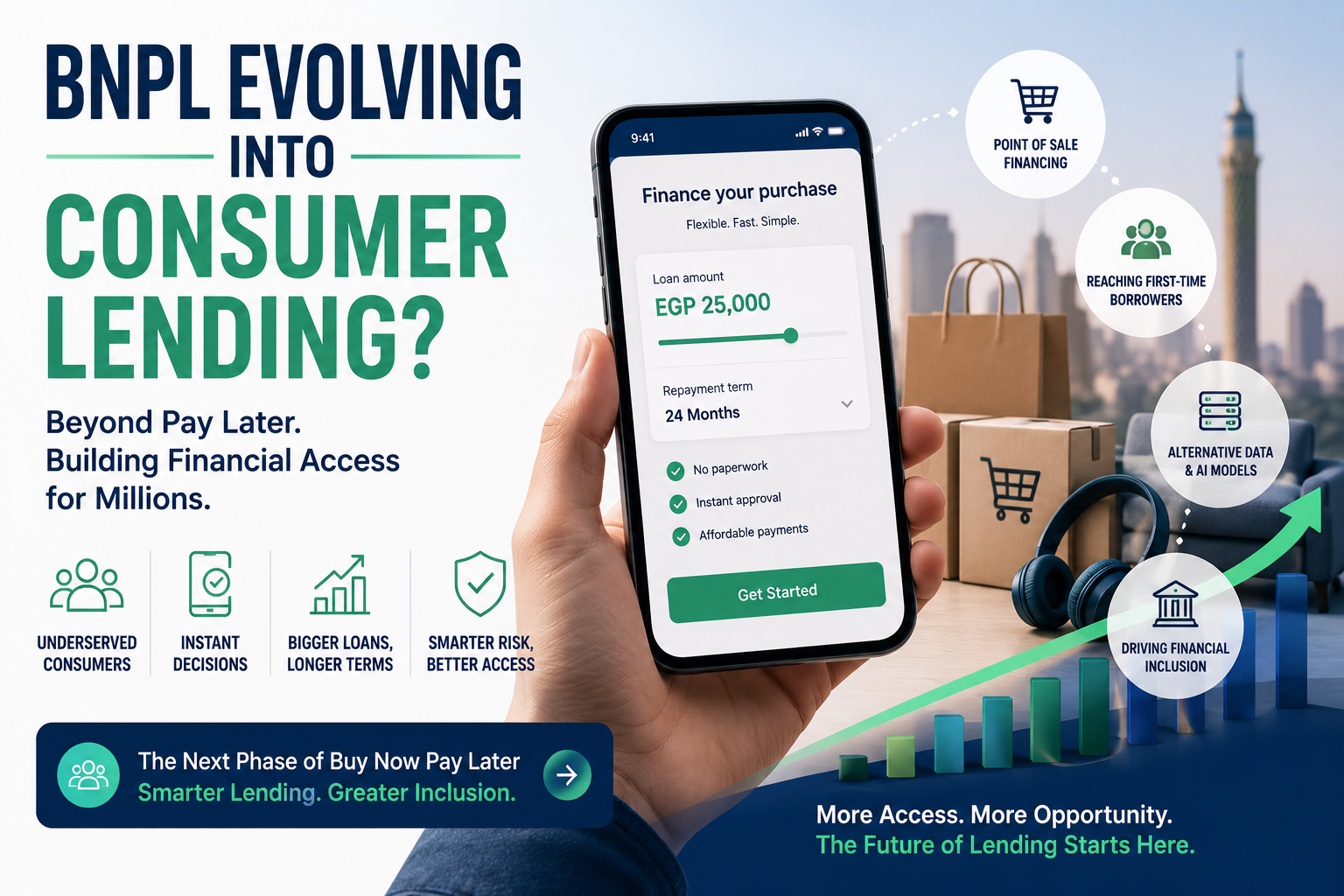
For years, Buy Now Pay Later providers have positioned themselves as something different from traditional lenders.
The appeal was obvious. Consumers could spread the cost of a purchase without lengthy paperwork, branch visits or complicated credit applications. Retailers benefited from higher conversion rates, larger basket sizes and a smoother checkout experience.
But as the Buy Now, Pay Later market continues to mature, an important question is emerging.
Is BNPL still primarily a payment solution, or is it gradually evolving into consumer lending?
Recent developments in Egypt suggest the answer may be more significant than many people realise.
The Future Of BNPL May Be About Credit Access
Egyptian fintech Blnk recently raised $37.1 million in equity and debt financing to expand its lending operations.
At first glance, the company appears to operate within the familiar Buy Now Pay Later space. Customers can access financing at the point of sale and repay purchases over time.
However, Blnk’s model differs from many traditional BNPL providers.
Rather than focusing primarily on short-term instalment plans, the company offers financing periods ranging from six to thirty-six months. More importantly, it actively targets consumers who have little or no formal credit history.
According to the company, approximately 75% of its customers have never previously borrowed through the formal financial system.
That statistic highlights a potentially important shift in the future of consumer finance.
While the first generation of Buy Now Pay Later growth focused on improving the checkout experience, the next generation may focus on expanding access to credit itself.
Buy Now Pay Later Has Already Changed Consumer Expectations
One reason BNPL has grown so quickly is that it has changed how consumers think about borrowing.
Traditional lending often involves paperwork, waiting periods and formal banking relationships. Buy Now Pay Later providers demonstrated that credit decisions could be made in seconds rather than days.
Consumers became comfortable applying for finance at the point of sale, whether purchasing electronics, furniture, travel bookings or home improvements.
As a result, millions of people who might never have considered applying for a traditional loan became comfortable using instalment finance.
In many ways, Buy Now Pay Later has acted as a gateway product into consumer lending.
The question now is whether providers can take the next step.
Alternative Credit Scoring Is Opening New Opportunities
Historically, lenders relied heavily on credit scores and borrowing history when assessing applications.
The challenge is obvious.
If somebody has never borrowed before, there may be very little data available to evaluate risk.
This has created a significant barrier for consumers across many emerging and developing markets.
Today, fintech lenders are increasingly using alternative credit-scoring models to address this problem.
Instead of relying solely on traditional credit reports, lenders can analyse broader data points, such as spending behaviour, transaction patterns, repayment habits, and other digital indicators.
Blnk says it uses internally developed machine learning models and alternative data to assess customers who often have little or no formal credit history.
This approach is becoming increasingly common across the digital lending sector.
The rise of alternative credit scoring could become one of the most important BNPL market trends over the next decade, as it enables providers to assess consumers who would previously have been excluded from traditional lending systems.
Financial Inclusion Could Become The Industry’s Next Growth Story
Much of the Buy Now Pay Later industry’s early growth came from consumers who already had access to financial products.
Many BNPL users also held credit cards, personal loans or overdraft facilities. The attraction was often convenience rather than necessity.
However, financial inclusion presents a much larger opportunity.
Millions of adults worldwide remain outside the formal banking system despite having stable incomes and regular spending habits.
These consumers often struggle to access traditional forms of credit because they lack established financial records.
Technology-driven lenders increasingly see this as an opportunity rather than a problem.
By using alternative data and digital underwriting models, they can potentially provide access to consumer finance for entirely new groups of borrowers.
For providers seeking future growth, serving first-time borrowers may represent a larger opportunity than competing for customers who already have access to multiple forms of credit.
What This Means For Retailers
The evolution of Buy Now Pay Later into broader consumer lending could have significant implications for retailers.
Traditional BNPL products have generally focused on relatively short repayment periods and lower-value purchases.
As lenders become more sophisticated, retailers may gain access to financing solutions that support larger purchases and longer repayment schedules.
Point-of-sale financing is already expanding beyond fashion and consumer electronics into sectors such as healthcare, home improvements, automotive services, and professional services.
If lenders become more effective at assessing underserved consumers, retailers could potentially reach customers who previously lacked access to suitable financing options.
This may be particularly valuable in markets where credit card usage remains relatively low.
The ability to offer accessible consumer lending directly at the point of sale could become an increasingly important competitive advantage.
Regulation May Accelerate The Transition
Interestingly, this evolution is occurring alongside increasing regulatory oversight.
In the UK, new FCA rules will bring many Buy Now Pay Later products under formal regulation from July 2026.
Some industry participants view regulation as a challenge. However, there is another way to look at it.
As BNPL providers move closer to mainstream consumer lending, greater regulatory oversight may reflect the industry’s increasing maturity.
Affordability assessments, clearer disclosures, complaint-handling procedures, and stronger consumer protections are all features commonly associated with established lending markets.
If Buy Now Pay Later providers want to play a larger role in consumer finance, regulation may be a natural part of that journey.
The Next Phase Of Consumer Lending
Not every BNPL provider will transform into a full-scale consumer lender. Many will continue focusing on short-term instalment products and retail checkout finance.
Others may specialise in particular sectors or customer groups. Yet the underlying technology that powered the rise of Buy Now Pay Later has applications far beyond splitting a purchase into three payments.
Real-time decision-making, digital onboarding, alternative credit scoring, and automated risk assessment can all be applied across the wider consumer lending market.
Companies that master these capabilities may find that Buy Now Pay Later was never the end goal.
Instead, it was the first step towards building a new generation of consumer finance businesses.
Conclusion
The rise of companies such as Blnk suggests that the future of Buy Now Pay Later may not be defined solely by how consumers pay for products.
It may increasingly be defined by who gains access to credit.
For years, the BNPL sector has focused on creating a faster and more convenient checkout experience. Increasingly, providers are looking beyond the checkout and towards a much larger opportunity: bringing first-time borrowers into the formal financial system.
If that trend continues, Buy Now Pay Later may evolve into something much broader than a payment solution.
It could become one of the most important gateways into consumer lending and financial inclusion worldwide.


